











Why Your Infinix Phone Dies After Two Years

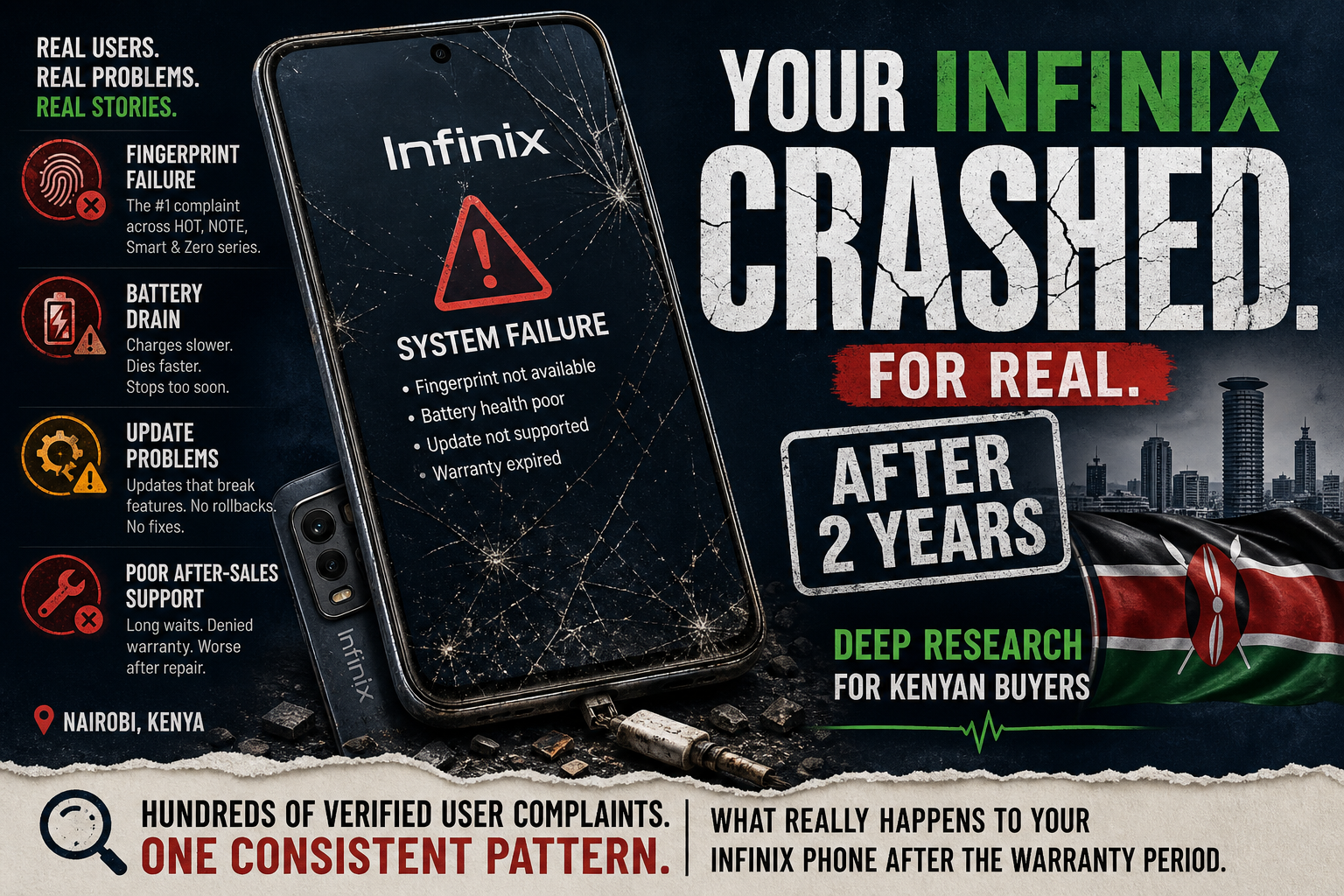
Why Your Infinix
Dies After Two Years
Hundreds of real users. One consistent pattern. What actually happens to your Infinix phone after the warranty period — and why every Kenyan buyer deserves to know.
PissedConsumer
Sentiment
budget models
analysed
You know the feeling. You save up, you read the specs — big battery, good camera, great price. You buy the Infinix. For 18 months, it's fine. And then, quietly, something changes.
If you have bought an Infinix phone in Kenya — from a shop in Nairobi's CBD, Westlands, or on Jumia — you have likely had this conversation with yourself somewhere around month twenty. The fingerprint stopped working. The battery drains by noon. An update arrived, and afterwards something else broke. The phone that once felt like a deal begins to feel like a deadline.
This is not a personal complaint, and it is not isolated. After analysing hundreds of documented user reviews from platforms including PissedConsumer, iFixit, GSMArena, and the consumer complaint platform Sikayetvar, a pattern emerges — consistent across models, consistent across countries, and deeply relevant to budget smartphone buyers across East Africa.
This article documents that pattern — not to condemn a brand, but because understanding what real users say, in their own words, on public platforms, is exactly what every buyer deserves before spending their money.
The Fingerprint Disappears
Of all the complaints catalogued, the most striking is also the most mundane: the fingerprint sensor simply stops working. Not because the phone was dropped. Not because it got wet. It just stops. In many cases, the biometric option vanishes from the settings menu entirely — as though the phone has decided it never had one.
This complaint spans models and years in a way that is difficult to dismiss. On GSMArena, a user reviewing the Infinix Zero 5G — a mid-range device launched in 2021 — wrote in December 2024:
"I got my Infinix Zero 5G around 2021 I think. Never fell off ground or water. But its fingerprint and vibrate suddenly don't work anymore, again no physical damage has been made. The last update I was able to get is from October 2023 and no more available after that."
The detail that cuts deepest is not the broken fingerprint — it is the date of the last available update: October 2023. A phone purchased in 2021, left without software support after roughly two years, now failing at one of its core security functions. Another user on the same thread replied:
"Same problem happen with me, it never fell in ground or water but still my fingerprint sensor is not working, also [the] setting is also missing and restarting doesn't change anything."
On PissedConsumer, a verified reviewer wrote in 2024:
"Its fingerprint sensor has disappeared from the [settings], selfie camera is not working and normal camera is not clear as usual after [purchasing]."
On a Carlcare community thread for the HOT 30 series, a user wrote urgently: "INFINIX HOT50i lost its fingerprint after the recent update. Please fix." And on iFixit, where the HOT 10i thread has accumulated years of responses, one entry from August 2024 simply reads: "I have Infinix Note 10 Pro mobile and its fingerprint is not working."
What is consistent across all these cases is the absence of a satisfying resolution. Carlcare's own documentation acknowledges that fingerprint failure can result from software glitches, outdated firmware, or hardware sensor damage — but for many users, by the time the problem surfaces, the software update path has already been permanently closed.
When the Update Becomes the Problem
There is something deeply counterintuitive about a software update that breaks the device it was meant to improve. And yet this is a recurring theme across Infinix complaint threads — the OTA (over-the-air) update that arrives as a fix and leaves something worse behind.
One of the clearest examples comes from Sikayetvar:
"I purchased my Infinix GT 20 Pro about a year ago, and after installing the latest software update on July 5, I began experiencing a serious internet connectivity issue. Before the update... I could fix the problem by switching the network setting — [after the update] even that workaround no longer works."
For Kenyan users — where mobile data is often the only internet connection at home — losing reliable connectivity after an update is not a minor inconvenience. It can mean losing access to work, M-Pesa transactions, and family communication. The bind becomes painfully clear when you read the response from an InfinixMob administrator to a HOT 30 user requesting a more stable OS version:
"The Infinix HOT 30 isn't eligible for any major Android updates." — InfinixMob Admin Response · HOT 30 Community Thread
That single sentence encapsulates the bind. The phone receives a security patch — not a full upgrade — and something breaks. But the path to a newer, more stable Android version is permanently closed. The user is left with an older OS that was just made less functional by the only update it will ever receive.
On PissedConsumer, a user documented the HOT 12 fingerprint vanishing specifically post-update:
"My fone Infinix Hot12 fingerprint option missing [after] new update. But [the] fingerprint [is] not showing. Help Infinix team."
The Battery, the Port, the Slow Decline
Battery complaints follow a slow, entirely predictable arc: a phone that once charged in under an hour now takes three to five, or stops charging entirely. On GSMArena, a user reviewing the Infinix Zero 5G wrote in April 2025:
"I got mine for almost 3 years now. Recently, my charging port is not charging well... It usually charge[d] for less than an hour but now it takes me to charge for like 3–5 hrs."
Another user on the same thread added a software-triggered wrinkle: "Safe charging pop[s] out and it can't be turned off. Now charging takes 5hrs. Infinix useless phone."
On Sikayetvar, a user documented complete charging failure at just one year of use:
"My Infinix Hot 20i phone was working normally, but the next day it stopped charging completely... The phone is only one year old, and I have cleaned the charging port, but nothing has changed."
A verified buyer flagged by PissedConsumer as located in Nairobi, Kenya documented overheating beginning at just two months of use:
"I purchased my Infinix phone with high hopes, but my experience has been nothing short of frustrating. From the second month of use, the phone started overheating excessively — even in cold weather. I don't keep it in my pocket, yet it still heats up significantly. Additionally, the phone frequently hangs and sometimes shuts itself down unexpectedly."
Verified Buyer · Nairobi, Kenya · PissedConsumer · October 2024
The Service Centre Experience
A phone that fails is frustrating. A phone that fails and cannot be repaired is something else entirely. Across platforms, the complaint does not end with the device — it continues into the service experience that follows.
One of the most striking reviews on PissedConsumer came from a user who took their device to a Carlcare centre and came back with something worse:
"I will never buy Infinix nor will I refer it to anybody because this company does not provide good service. Its service is very bad, it wastes a lot of customer's time. Then they damaged my phone more than before and the service center's behaviour is very bad."
"My phone has been out of order for the last 15 days, and your service center personnel have not been able to repair my phone properly. They keep taking time, and I am suffering a lot because of Infinix."
Several reviewers reported submitting devices under active warranty only to be turned away:
"My phone is under warranty, [it] has some network issue and fingerprint issue and I visited the service center and then [handed over] my phone. [A] few days [later] he denies to help. I need help."
These are individual accounts and do not represent every Carlcare interaction in Kenya or globally. But their volume and consistency — across geographies, models, and years — points to a support infrastructure under significant strain in the very markets where Infinix has built its largest user base.
The Software Support Ceiling
If there is one structural fact that ties together the experiences documented above, it is this: Infinix phones are built with a short software support lifecycle — and that ceiling falls precisely when hardware problems typically arrive.
According to publicly documented policy analysed by InfinixMob, the update commitment by series is as follows:
| Series | Major Android Updates | Security Patches | Verdict |
|---|---|---|---|
| ZERO / NOTE / GT | 2 updates | 36 months | Moderate |
| HOT (standard) | Unclear / 1 at most | 24 months | Weak |
| SMART series | None guaranteed | 24 months | Poor |
| XPAD / budget | None guaranteed | 24 months | Poor |
| Samsung / Google (comparison) | 7 years | 7 years | Industry Leader |
InfinixMob, which tracks Infinix's update schedules, summarised the reality plainly:
"Infinix phones have a lifespan of 2 years and at most 3, of which the last will be for security upgrade only, having reached end-of-life support in the second year."
InfinixMob · Infinix Software Update Policy & End-of-Life Timeline · 2025
"Once an Infinix phone reaches End-of-Support and security patches stop, it becomes vulnerable to new malware. Within 2–3 years of EOS, some banking and high-security apps may also stop working due to outdated Android compatibility."
For Kenyan users, this is not abstract. Mobile banking — M-Pesa, KCB Mobile, Equity, Co-op Bank — is essential infrastructure, not an optional app. A phone that can no longer run banking apps because its Android version is too old is, in practical terms, no longer a functioning smartphone. As Gizmochina noted, while Samsung and Google now offer seven years of Android updates on flagship devices, Infinix offers two — and only on its higher-end lines. The HOT and SMART series, the models most Kenyans actually buy, get even less.
What Users Actually Say They Want
It would be unfair to characterise every Infinix user as simply dissatisfied. The same review platforms that surface these complaints also contain users who appreciate the brand's pricing, large screens, and generous battery capacities. On PissedConsumer, 35% of reviewers say they would recommend the brand. That is not nothing — and it reflects a real truth: for many Kenyan buyers, Infinix represents genuine value at a price point where alternatives are limited.
One reviewer, in the middle of documenting frustrations, paused to write a feature request that reveals genuine investment in the product:
"I kindly request the addition of a 'Screen Off While Playing Video' option, allowing users to turn off the display while continuing audio playback... Many users rely on background audio for daily activities, but currently, the screen must remain active during playback, draining battery unnecessarily."
This is not the language of someone who has given up on the brand. It is the language of someone who wants it to be better.
The complaints documented throughout this article are not arguments against affordable smartphones. When read carefully, they are complaints about a gap — between the promise of a device and the reality of what happens to it after twenty-four months. They are complaints about software support windows that close before the hardware problems arrive. They are complaints about a service infrastructure that cannot absorb the volume of issues that result.
Whether Infinix addresses that gap — through longer update commitments, stronger quality control, or improved Carlcare capacity in Kenya — will determine whether the next generation of user reviews sounds the same.
For now, the record speaks for itself.
Have you experienced this with your Infinix?
We build community trust through real research, verified evidence, and honest conversations. Drop your experience in the comments — your story could help the next Kenyan buyer make a smarter decision.
Share Your Experience ↓